Episode 1 · Little's Law
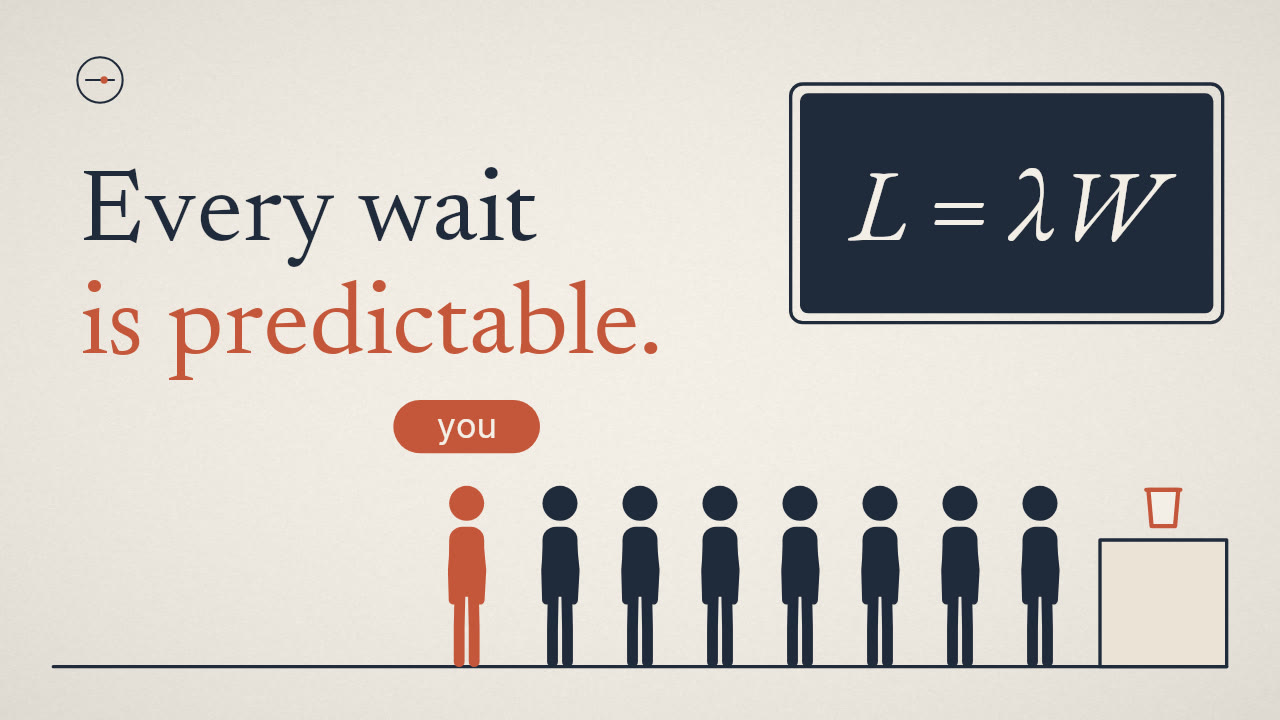
Every wait is predictable.
You walk into a coffee shop. Ten people are ahead of you, and the barista gets about two out the door every minute. You'll wait five minutes. That little division runs far more than coffee lines.
Free cheat sheet
Little's Law on one page
The formula, the three uses, every worked example from the episode, when it breaks down, and a ten-minute exercise for this week. Print it or keep it open in a tab. No sign-up.
The formula
L = λW. L is the average number of things inside the system: people in line, tickets in the queue, machines in the shop. λ (lambda) is the average rate at which they arrive. W is the average time each one spends inside.
In a stable system about as much leaves as arrives, so the arrival rate is also your throughput. Flip the formula and you get the most useful version:
Time in system = items in system ÷ throughput. Know any two, and the third is fixed. Not estimated. Fixed.
John Little published the first general proof in 1961, in Operations Research. It doesn't care what the work is, how things arrive, what order they're served in, or how many people serve them. If the system is stable, the law holds.
Worked examples from the episode
| Situation | Math | Answer |
|---|---|---|
| Coffee shop: 10 people ahead, about 2 served a minute | 10 ÷ 2 | 5 minutes |
| Restaurant, in reverse: 60 seats all full, guests stay 1.5 hours | 60 ÷ 1.5 h | 40 guests / hour of capacity |
| Support queue: 200 open tickets, 50 closed a week | 200 ÷ 50 | 4 weeks |
| Repair shop: 300 machines in, 100 fixed a day | 300 ÷ 100 | 3 days out of service |
| Goal of 1.5 days, lever 1: shrink the queue to 150 | 150 ÷ 100 | 1.5 days |
| Goal of 1.5 days, lever 2: raise throughput to 200 a day | 300 ÷ 200 | 1.5 days |
Examples are illustrative numbers, not real data.
The only two levers
A wait only gets shorter if one of two numbers moves: shrink the queue or raise throughput. Motivational emails, new dashboards, escalation calls, and working harder on the same capacity don't change the average. Expediting moves one item to the front and pushes everyone else back.
Shrinking the queue is usually a decision you can make this week. Raising throughput usually takes people, money, or a fix to the bottleneck. Know which one you're asking for.
When it lies
- It needs a steady state. If arrivals and completions aren't roughly equal over your window, the honest answer is "the wait is getting longer."
- Keep units and the window consistent. 200 tickets ÷ 50 a week is 4 weeks, not 4 days. Measure all three numbers over the same period.
- Averages, not individuals. A four-week average hides tickets closed in a day and ones forgotten for months.
- It tells you what, not why. To learn why throughput is low, find the bottleneck. That's the next episode.
Try this week
Pick one queue you own or depend on. Write down how many items are in it now, how many finished last week, and how many arrived last week. If the last two are close, divide the first by the second. That's your average wait. Compare it with what people believe the wait is, and ask: too much in the queue, or too little throughput?
"Our wait is queue size divided by throughput. To cut it, we either finish more each day or let less in. Which one are we choosing?"
Source: John D. C. Little, "A Proof for the Queuing Formula: L = λW," Operations Research 9(3), 383–387 (1961). doi.org/10.1287/opre.9.3.383